



Table of Content
Created at
Written by
Founder JobCompass.ai
Oct 3, 2025
Share with:
message to hiring manager, job search tips, career advice, networking outreach, job application
published
Sending a carefully written message to a hiring manager is one of the smartest things you can do to get noticed. It lets you cut through the noise of online applications and connect directly with the person who matters. Think of it less as an application and more as an introduction—a way to show you’re a proactive problem-solver.
Why Bother Messaging a Hiring Manager Directly?

Let's be real: the typical job application process feels like sending your resume into a black hole. Applicant Tracking Systems (ATS) are designed to filter people out, which means a real human might never even lay eyes on your qualifications. A direct, personal message is your ticket to bypass those automated gatekeepers.
Taking this extra step shows you have real initiative and a genuine interest in the company. It’s not about cutting in line; it’s about proving you’re the type of person who does their homework and makes things happen.
It’s All About the Human Connection
A direct message helps you build a rapport that a resume simply can't. Your application lists skills and experience, but a thoughtful note shows your personality, enthusiasm, and professional respect. That human touch can make all the difference.
You get to frame the conversation right from the start. Instead of being just another PDF in a massive folder, you become a person who reached out for a specific, compelling reason. This completely changes the dynamic.
A personalized message transforms you from a passive job applicant into an active business professional seeking a mutually beneficial connection. It shows you’re not just looking for any job, but their job.
Uncovering Opportunities No One Else Sees
This approach isn't just for jobs you see posted online. It’s also a fantastic way to tap into the hidden job market—those roles that are filled before they're ever advertised. A great message can spark a conversation that leads to an informational interview or puts you top of mind for a future opening.
To really nail this, it helps to see things from their perspective. Understanding modern candidate sourcing methods gives you an edge because you start to think like a recruiter. By showing you’ve done your research, you instantly signal a few key things:
You stand out. Most people just click "apply" and hope for the best. Your direct outreach makes you memorable.
You show you actually care. Finding the right person and writing a custom message proves you’re serious about this company.
You demonstrate resourcefulness. The skill of identifying and connecting with the right people is valuable in any role.
Your Pre-Outreach Research Checklist

Before you even dream of hitting "send" on a message to a hiring manager, you have to do your homework. There's simply no way around it. Firing off a generic, uninformed email is the quickest way to land in the trash folder, and I've seen it happen countless times.
Good research is what separates a message that actually starts a conversation from one that’s deleted on sight.
This isn’t about becoming a private investigator. It’s about finding a few key pieces of information that give you a genuine, specific reason to connect. This prep work shows you respect their time and immediately puts you ahead of the 90% of other people who are just blasting out copy-pasted templates.
Pinpoint the Right Person
First thing's first: you have to find the right person. A brilliant message sent to the wrong individual is just digital noise. While general titles like "Hiring Manager" or "Recruiter" are okay in a pinch, your message will have so much more impact if you can find the person who actually leads the team you want to join.
Look for Department Heads: Think titles like "Director of Marketing," "VP of Engineering," or "Sales Manager."
Find the Team Leads: For more granular roles, the decision-maker might be a "Lead Software Developer" or "Senior Content Strategist."
Finding them can take a bit of detective work, mostly on LinkedIn. If you're hitting a wall, our detailed guide on how to find the hiring manager has some great strategies to track down the right contact.
Analyze Their Professional Footprint
Okay, you’ve found your target. Now it’s time to dig a little deeper. The goal here is to find a natural "in"—something you can reference that makes your message feel personal and timely, not like it came off an assembly line.
The best outreach feels less like a job application and more like the start of a real professional conversation. Your research is what gives you that perfect opening line.
Look for specific details that prove you’re paying attention. Did they just publish an article on a topic you’re passionate about? Speak at a conference? Maybe they commented on a post about a new industry trend that lines up with your own expertise.
Here’s a quick list of what I always look for on their profiles and company pages:
Recent Activity: What have they posted, commented on, or shared recently on LinkedIn?
Company News: Any big product launches, funding rounds, or mentions in the press?
Shared Connections: Do you know anyone in common? A mutual connection is a golden ticket.
Professional Background: Check out their career path. Did they work at a company you admire or go to the same university?
Finding just one of these little details gives you an authentic hook. Mentioning their recent blog post on AI in marketing or congratulating them on the company's new feature release shows you’ve done more than just scan their job title. It's a small effort that transforms your cold email into a warm, informed introduction.
The Anatomy of a Compelling Outreach Message
Let’s get past the cookie-cutter templates and break down what actually goes into a message that a hiring manager will read and respond to. A truly effective outreach message isn’t just a single block of text; it's a carefully crafted piece of communication made of four distinct parts, each with a specific job.
Think of it as a strategic conversation starter, moving from grabbing their attention to clearly outlining the next step.
This infographic gives you a great visual overview of the flow: a solid greeting, a body that screams "value," and a simple call to action.
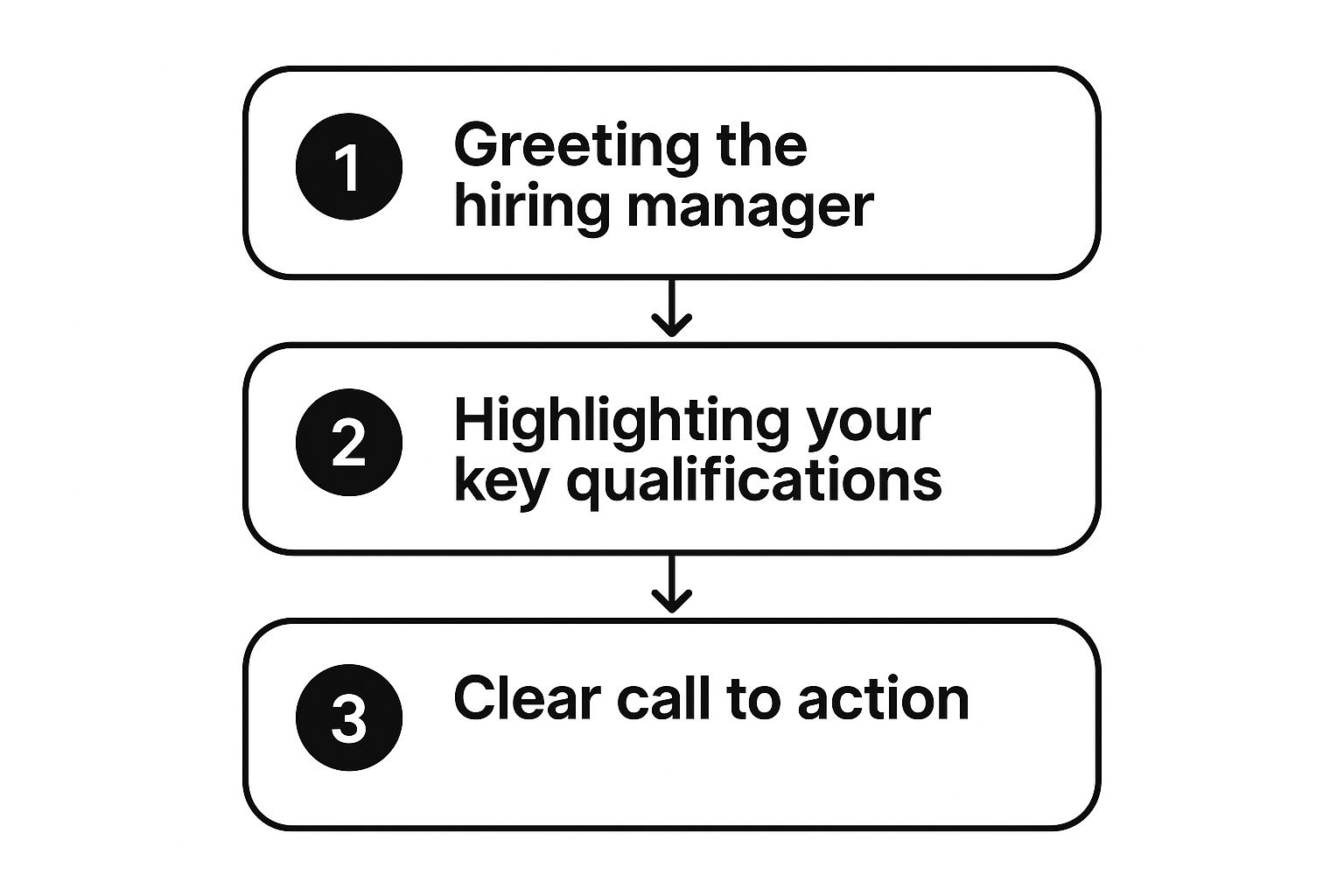
When you structure your message this way, you make it incredibly easy for a busy manager to understand who you are, what you want, and what to do next.
To help you get this right, let's look at the key components that make up a successful outreach email and why each one is so important.
Key Message Components and Their Purpose
Component | Objective | Example Snippet |
|---|---|---|
Subject Line | Get your email opened. It must be clear, professional, and intriguing. | "Referral from Jane Doe for Product Manager role" |
Opening Hook | Create an immediate, personal connection. Show you've done your research. | "I saw your team's recent launch of the new dashboard—congrats on the feature." |
Value Proposition | Connect your skills directly to their needs or challenges. | "...grew user engagement by 45% by..." |
Call to Action | Make it easy for them to say "yes" to the next step. | "Are you free for a quick 15-minute chat next week?" |
Each of these pieces works together to build a compelling case for why they should take a few minutes out of their packed schedule to talk to you.
The Subject Line That Gets Opened
Your subject line is your first impression, and it has one job: get your email opened. If it fails, nothing else matters. You want to be clear and professional, not spammy or vague. Forget the clickbait; aim for something that’s both informative and creates a bit of curiosity.
Here are a few angles that work well:
Mention the Role: Jump straight to the point (e.g., "Inquiry: Senior Marketing Role").
Lead with a Referral: This is gold. Always put it front and center (e.g., "Jane Doe suggested I reach out about the Product Manager position").
Hint at Your Value: Briefly show what you bring to the table (e.g., "Experienced SaaS Sales Leader interested in [Company Name]").
This first touchpoint sets the tone for everything that follows. For a deeper dive into crafting that perfect opener, check out our guide on how to write effective cold emails.
The Personalized Opening Hook
This is where your research pays off. Those first couple of sentences absolutely must show that you’re writing directly to them, not just blasting a template to a hundred people. A generic "Dear Hiring Manager" is an instant trip to the trash folder.
Your opening line is your chance to build an instant, genuine connection. It proves you’ve done your homework and aren't just sending out mass emails.
Kick things off by mentioning something specific. Did the company just hit a major milestone? Did the manager write an interesting article on LinkedIn or speak on a podcast? Referencing it shows you have a real interest in their work and that you respect their time enough to learn something about them first.
The Body Highlighting Your Value
Alright, now it’s time to connect the dots between your background and their needs. This is the heart of your message, but how you frame it is critical. Don't just copy and paste bullet points from your resume. That’s lazy and unhelpful.
Instead, think like a problem-solver. How have you tackled challenges similar to what their team is likely facing? Use specific numbers and results to back it up.
Instead of: "I was responsible for social media."
Try: "At my last company, I grew social media engagement by 45% in six months after launching a new content strategy. I saw you're aiming to expand your audience, and I believe a similar approach could work well."
See the difference? You're no longer just a job seeker; you're a potential solution.
The Clear and Simple Call to Action
Finally, tell them exactly what you want to happen next, and make it ridiculously easy for them. A weak closing like "I look forward to hearing from you" is a dead end. It puts all the work on them to figure out what to do.
Your call to action (CTA) needs to be a direct but low-effort question. You’re aiming for a quick "yes" or a simple scheduling click.
For example: "Would you be open to a brief 15-minute call next week to discuss how my background in user acquisition could support your team's upcoming launch?" It's specific, respects their time, and clearly moves the conversation forward.
Making Your Message Genuinely Personal
If your outreach message could be copy-pasted and sent to ten different companies, you’ve already lost. It’s a simple test, but it’s the one that separates a message that gets an immediate reply from one that’s instantly deleted.
True personalization isn’t just about dropping their name in the first line. It’s about showing you’ve done your homework and are reaching out for a specific, thoughtful reason. You want the hiring manager to feel like you’re speaking directly to them and no one else.
Think of it this way: the phrase "I saw your profile on LinkedIn" has become a huge red flag. It immediately signals a low-effort, generic approach. Your goal is to prove you’re not just looking for any job—you're genuinely interested in their company and what their team is building.
This level of detail respects their time because it shows you’ve already invested your own.
Digging for Authentic Connections
So, where do you find these personal details? The key is to find a connection that you’re actually interested in, something that links back to your own skills or passion.
Here are a few goldmines for finding that perfect angle:
Recent Company Wins: Did the company just launch a flagship product? Close a major round of funding? Maybe they published a fascinating case study that caught your eye. Mentioning a specific win shows you’re following their journey.
The Manager's Own Work: This is often the best approach. Look them up online. Have they written an article, appeared on a podcast, or shared a strong opinion on an industry trend? Referencing their work is a powerful way to build rapport.
Shared Professional Interests: Maybe you both follow the same industry experts on social media or have commented on the same threads. Highlighting this common ground creates an instant, natural connection.
A truly personal message makes the recipient feel seen and understood. It’s not about flattery; it’s about showing you’ve connected the dots between their world and yours.
For example, instead of a vague statement about your skills, you could reference a specific feature in their latest software update. Then, you can explain how your experience in user feedback analysis could directly help them improve it. Now that's a message that stands out.
Striking the Right Conversational Tone
Personalization is also about how you say it. Your message should be confident and professional, but it also needs to be conversational. You aren't writing a stuffy, formal cover letter; you're starting a dialogue between two professionals.
Avoid stiff, corporate language. Imagine you're reaching out to a respected peer you'd like to work with, not a faceless gatekeeper. This makes your outreach feel less like a cold email and more like the start of a genuine relationship.
This human touch is more important than ever. With 71% of teams now recruiting beyond their local markets, the talent pool is global. A personalized, human connection can easily bridge geographical and cultural gaps, making you memorable in a sea of applicants. You can find more data on global hiring trends and recruiting statistics on SelectSoftwareReviews.
Ultimately, a great message to a hiring manager feels authentic. It shows you’re a thoughtful, resourceful person who took the time to understand their world before asking for their attention. That effort alone is often enough to get your foot in the door.
How a Direct Message Bypasses the Hiring Bots
It's a frustrating reality of modern job hunting: some of the most qualified candidates are rejected before a real person ever lays eyes on their resume. The culprit? The Applicant Tracking System, or ATS, which many of us just call the "hiring bot."
These automated systems scan and filter mountains of applications, looking for very specific keywords and formatting. If your resume doesn't use the exact phrases the ATS is programmed to find, you're out of the running. It doesn't matter how perfect you are for the role. The bot is a digital gatekeeper, and it makes no exceptions.
This is exactly why sending a direct message to a hiring manager is such a game-changer. It's your secret pass to skip the automated screening line entirely. Your message lands right in a decision-maker's inbox, giving you a chance to make a genuine human connection—one based on the value you bring, not on how well you matched some keywords.
The Problem with Automated Screening
The sheer number of companies using these bots makes a direct approach more important than ever. A staggering 97.4% of Fortune 500 companies rely on an ATS to sort through candidates. While smaller companies might not use them as often, if you're aiming for a top job at a large organization, you’re almost certainly facing an algorithm first. You can dig into more of the numbers in these recent recruitment statistics from Recruiterflow.
An ATS can't read between the lines. It doesn't understand context, ambition, or how your skills from one industry could be a massive asset in another. A direct message puts the human element back into hiring and lets you tell the story the bots would otherwise miss.
Of course, for any online application, it's still smart to understand strategies to beat ATS systems. But your best move is always to connect with a person who can see your potential and pull your resume from the pile. For a deeper dive, check out our guide on https://jobcompass.ai/blog/how-to-beat-applicant-tracking-systems.
Connecting Your Message to Your Application
When you send that direct message, it’s a good idea to mention that you've also completed the formal application. It’s a small detail, but it helps the hiring manager connect the dots and see you as a serious, thorough candidate.
You can frame it simply and professionally:
"I also just submitted my formal application through your careers portal, but I wanted to reach out personally to express my strong interest."
"After applying online for the Product Manager position, I felt compelled to connect directly and share a bit more about why I’m so excited for this opportunity."
This positions your message as a proactive follow-up, not an attempt to cheat the system. It shows you respect their process but are also driven enough to make sure you don't get lost in the digital shuffle. It's a smart, two-pronged attack that can make all the difference.
Got Questions? Let's Clear Things Up
Sending that first message to a hiring manager can feel a little high-stakes, I get it. Even when you’ve got the perfect template, your finger might hover over the “send” button. It’s totally normal to second-guess the timing or worry about the follow-up.
Let's walk through some of the most common questions that pop up. Once we clear these hurdles, you'll feel much more confident hitting send.
When Is the Best Time to Actually Send This Thing?
You've probably wondered if your perfectly crafted message will just get lost in a Monday morning email tsunami. You're right to think about it—timing matters. While there's no magic formula, you can definitely play the odds.
Your safest bet is to aim for standard business hours in their local time zone. I've always had the best luck mid-morning during the middle of the week.
Sweet Spot: Think Tuesday through Thursday, somewhere between 9:00 AM and 11:00 AM.
Times to Dodge: Avoid Monday mornings when everyone is digging out from the weekend. Friday afternoons are also a dead zone as people are mentally checking out. And definitely no late-night messages.
Sending it during these prime times means your email is more likely to be sitting right at the top of their inbox when they’re actually focused and ready to engage.
How Long Should I Wait Before Following Up?
So you sent the message... and now you hear crickets. Don't panic. A lack of response doesn't automatically mean "no." Hiring managers are juggling a million things, and your email could have just slipped through the cracks.
Patience is a virtue here, but so is persistence. A polite, brief follow-up after about a week is standard professional courtesy. It shows you're genuinely interested without being a pest.
If a full week goes by, it's time to send a gentle nudge. Just reply to your original message to keep the context. Something simple like, "Hi [Name], just wanted to briefly follow up on my note from last week. I’m still very interested in the [Job Title] role and would love to connect when you have a moment," works perfectly.
Should I Bother Reaching Out if There’s No Job Opening?
Yes! A thousand times, yes. This is how you tap into the "hidden job market." So many positions are filled through networking and referrals long before they ever see the light of day on a job board. Being proactive puts you on their radar for roles that don't even exist yet.
The key is to change your angle slightly since you can't reference a specific job posting.
Lead with genuine admiration. Talk about what draws you to the company. Was it a recent product launch, a feature in the news, or their company culture? Get specific.
Make it an exploratory conversation. Explain that you're keeping an eye on the industry and that their company stands out.
Ask for a quick chat, not a job. The goal is an informational interview. Ask for 15 minutes of their time to learn more about the team and what they're working on.
This approach frames you as a savvy professional building connections, not just another person asking for a job. It's a soft, low-pressure way to start a conversation that could lead to something big down the road.
Ready to stop guessing and start connecting with the right people? Job Compass gives you the tools to find hiring managers, craft the perfect outreach message with AI assistance, and track all your applications in one place. Double your interview rate by turning cold outreach into warm connections. Start finding your next job faster with Job Compass today.

