



Table of Content
Created at
Written by
Founder JobCompass.ai
Oct 9, 2025
Share with:
how to write cover letter, cover letter tips, job applications, career advice, cover letter format
published
Think of a cover letter as your opening argument. It's where you step beyond the facts and figures of your resume to tell a story—one that directly connects your experience to what a company is looking for. This isn't about repeating your work history; it's about building a narrative that proves you're the solution to their problem.
Why Your Cover Letter Is Still Your Secret Weapon
Let’s be honest, writing a cover letter can feel like a chore from another era. With one-click applications and automated hiring platforms, it's tempting to ask, "Does anyone even read these anymore?"
The answer is a definite yes. Skipping it is a huge missed opportunity.
Your resume is the "what" and "where" of your career—a factual list of jobs, dates, and accomplishments. Your cover letter is the "why." It’s your best chance to show some personality, express real excitement for the role, and explain why your unique skills make you the perfect fit for this specific job.
It Makes You Human
A thoughtful letter turns you from a collection of bullet points into a real person. It’s your first opportunity to connect with a hiring manager, showing off your communication style and professionalism before you even get to an interview. This is where you prove you’ve done your homework and actually care about the company’s mission.
When a hiring manager is staring at a stack of similar resumes, a compelling story is what makes you stand out. It connects the dots between what you’ve done and what the company needs, making a strong case for why you should be on their team.
"Your cover letter is where you make a case for why you’d excel at the job, aside from what’s in your resume. A good cover letter can be the thing that gets you an interview."
That personal touch is often the tie-breaker between two equally qualified people. It signals initiative and a level of effort many applicants won't bother with, instantly putting you ahead of the pack.
The Numbers Don't Lie
Still not convinced? The data speaks for itself. Let’s look at just how much weight a cover letter carries in the hiring process.
Cover Letter Impact at a Glance
The statistics below highlight why ignoring the cover letter is a risk you can't afford to take. They show that recruiters and hiring managers consistently rely on them to screen candidates.
Statistic | Impact on Your Application |
|---|---|
83–94% of hiring managers | Actually read cover letters, even if they're listed as optional. |
45% of reviewers | Look at the cover letter before the resume, making it your true first impression. |
94% of hiring managers | Report that cover letters influence their interview decisions. |
The takeaway here is clear. As you can see from resources like The Interview Guys, these documents are far from obsolete.
This all confirms that learning how to write a great cover letter isn't just about checking a box—it's a strategic career move. It's a small investment of your time that can make all the difference in getting your application to the top of the pile.
The Anatomy of a Compelling Cover Letter
Forget the generic templates you see everywhere. A truly great cover letter has a natural, persuasive flow that tells a story—your story. It’s not just a document; it's a conversation starter.
Think of it as having four key parts, each with a specific job to do:
The Header: This is your professional handshake, setting the stage.
The Opening: Your chance to make a strong first impression.
The Body: The heart of your argument, where you connect the dots for them.
The Closing: Your confident final word that prompts them to act.
Once you get this structure down, you'll find it much easier to build a powerful, easy-to-read letter every single time.
Start with a Professional Header
First things first: your header needs to be clean, professional, and a mirror image of the one on your resume. This simple touch creates a polished, cohesive application package that looks intentional.
Make sure it includes your full name, phone number, email address, and a link to your LinkedIn profile. It's also standard practice to add the date, followed by the company's information. If you can find the hiring manager's name, use it! If not, don't sweat it—addressing it to the "Hiring Manager" or the "[Department Name] Team" is perfectly fine and completely modern.
The Attention-Grabbing Opening
Your first paragraph is your hook. It has to grab their attention immediately. State the role you're applying for, but don't stop there. Right away, tie your interest to something specific about the company—maybe it's their mission, a recent project you admired, or their company culture. This instantly shows you've done your homework and aren't just blasting out resumes.
Body Paragraphs That Connect Your Skills
This is where you make your case. The biggest mistake people make here is simply listing their skills. Don't do that. Instead, draw a direct line from your experience to the challenges you see in the job description.
Take a good look at the role's requirements and figure out what their biggest needs or pain points are. If you need a little help with this, our guide on how to find keywords in the job description is a great place to start.
Dedicate a couple of short paragraphs to highlighting 1-3 of your top achievements. The key is to show, not just tell. Use hard numbers and metrics to prove your impact.
For instance, instead of a vague statement like, "I'm good at social media marketing," try something with more punch:
"At my last job with XYZ Company, I took charge of a social media campaign that boosted audience engagement by 45% in just three months. This effort directly led to a 15% increase in qualified leads for the sales team."
See the difference? That’s a concrete result that demonstrates your value. This narrative approach is crucial for standing out. For more on building a story that sets you apart, check out these tips on How to Write a Personal Statement: Tips to Stand Out.
A Confident Closing and Call to Action
You've made your case, so it's time to end on a strong, proactive note. Briefly restate your enthusiasm for the role and your confidence in what you bring to the table.
Your final sentence needs to be a clear call to action. Passive phrases like "I look forward to hearing from you" are a missed opportunity. Be more direct and forward-thinking. Something like, "I am eager to discuss how my project management expertise can help your team deliver on its Q4 goals," is much more compelling.
Then, sign off with a professional closing. You can't go wrong with:
Sincerely
Best regards
Respectfully
Nailing this structure gives you a reliable roadmap for any application. It ensures your message is logical, persuasive, and, most importantly, gets read.
Crafting an Opening That Demands Attention

Let's be honest: your first sentence is a make-or-break moment. Hiring managers are drowning in applications, and a boring, predictable opening is the fastest ticket to the rejection pile.
Think about it from their side. They've seen "I am writing to express my interest in..." a hundred times today. Your job is to jolt them out of that haze and immediately show that you’re the candidate they’ve been waiting for.
From Generic to Genuine
The secret is to swap out those tired, formulaic lines for something that packs a punch. Lead with a major accomplishment, show you’re genuinely excited about the company's mission, or even mention a recent company win you admired.
This does take a little digging, but it’s worth it. A quick scan of the company’s recent news, blog, or social media feeds can give you the perfect angle. For more on this, our guide on how to research a company before an interview has some great tips that work just as well here.
A strong opening proves you’re not just looking for any job—you’re specifically interested in this job, at this company. It instantly changes the dynamic and makes the reader lean in.
Let’s look at a couple of real-world examples to see how small tweaks can completely transform your intro.
Before and After Examples
It’s amazing what a difference a personalized opening makes. Here’s a look at a common, weak start versus a much stronger alternative for two different roles.
Role: Marketing Manager
Weak Before: "I am writing to apply for the Marketing Manager position I saw advertised on LinkedIn. I believe my skills and experience would be a great fit for your team."
Strong After: "When I saw that your team recently won the 'Innovator of the Year' award for the 'GoGreen' campaign, I knew I had to apply. My work leading a campaign that grew our user base by 35% through similar eco-conscious messaging aligns perfectly with your team’s forward-thinking approach."
See the difference? The second one immediately connects the candidate's achievements to the company's recent success. It shows they've done their homework and are genuinely invested.
Role: Software Engineer
Weak Before: "Please accept this letter as my formal application for the Software Engineer role. I have several years of experience in Python and Java that are relevant to this position."
Strong After: "As a longtime user and admirer of your mobile banking app, I was particularly excited to see the opening for a Software Engineer. My experience in developing a secure payment gateway that reduced transaction fraud by 20% could directly support your mission to create the industry's most trusted financial platform."
Again, the "after" version is worlds better. It establishes a personal connection and ties a specific, measurable achievement directly to the company's own goals. You're not just applying for a job; you're starting a conversation and showing you're a problem-solver from the very first line.
Telling Your Story to Solve Their Problems
https://www.youtube.com/embed/g2b487nXaP0
The body of your cover letter is the main event. This is where you go beyond the pleasantries and prove you have what it takes to solve the company's real-world problems. The biggest mistake I see people make is just rehashing their resume. Please don't do that.
Your goal here is to connect the dots between your experience and the employer's needs. Think like a consultant. You’ve diagnosed their challenges from the job description, and now you’re presenting your past successes as the perfect solution.
Uncover the Real Problem
Every job posting is really just a story about a problem. A company is hiring a "Social Media Manager" because their brand isn't getting enough attention. They need a "Logistics Coordinator" because their supply chain is a mess. Your first job is to read between the lines and figure out that core challenge.
Hunt for action words and key requirements. If a job description keeps mentioning "streamlining processes" or "improving customer retention," you've found your target. That’s what you need to build your story around.
Use the Problem-Action-Result Framework
Once you’ve identified the problem, it’s time to show how you’ve tackled similar issues before. I’ve found the most powerful way to do this is with the Problem-Action-Result (PAR) framework. It's a simple, yet incredibly effective, storytelling tool.
Problem: Briefly describe the situation or challenge you were facing.
Action: Explain the specific steps you took to address it. This is where you show off your skills.
Result: What was the outcome? This is the most important part—always use numbers to quantify it if you can.
Using this method turns a boring job duty into a compelling success story. Let's look at an example.
Generic Statement (What to avoid): "I was responsible for managing the company blog."
PAR Statement (What to use): "The company blog was struggling with low traffic (Problem). I developed a new SEO-driven content strategy and implemented a consistent publishing schedule (Action), which increased organic search traffic by 60% in six months (Result)."
See the difference? This approach gives your claims some serious weight and shows the hiring manager the exact value you can bring to the table.
Are Cover Letters Still Relevant?
It's interesting because while this structured approach works wonders, the conversation around cover letters is definitely changing. MokaHR's 2025 analysis found that 84% of people believe traditional cover letters are outdated, and only 18% think they still hold value.
And yet, many employers disagree. Especially in communication-heavy industries (70%) and startups (65%), they still see them as a crucial tool for judging a candidate's problem-solving and communication skills. What this tells us is that while applicant opinions are shifting, a well-written, problem-solving letter is still a major advantage for a lot of roles.
The infographic below really drives home how much a targeted, problem-solving approach can outperform a generic one.
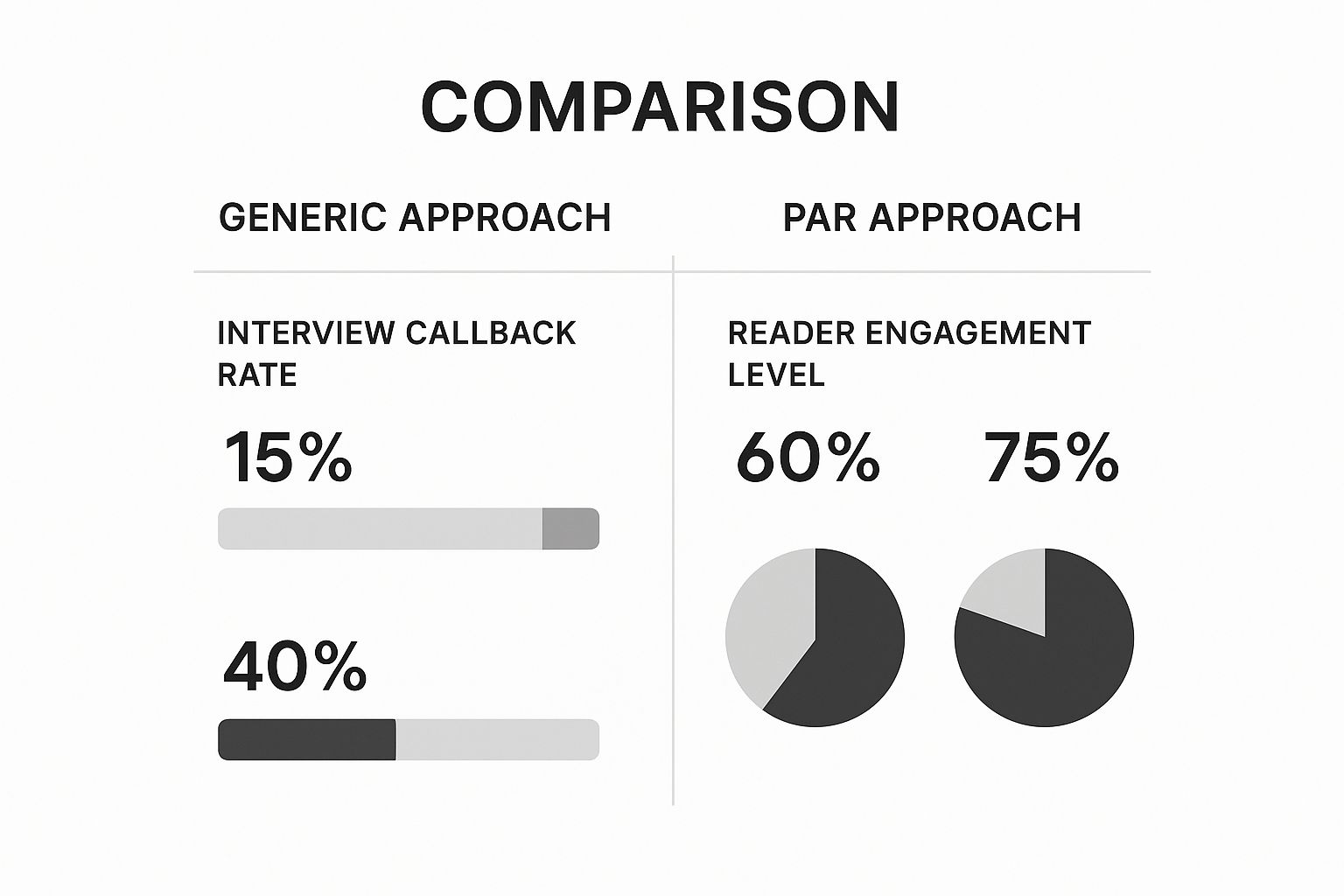
The data is crystal clear: when you shift from a generic summary to a PAR-driven story, you dramatically increase your odds of getting noticed and landing that interview.
When you focus your cover letter on solving their specific problems, you stop being just another applicant and become a candidate they need to talk to. You're not just asking for a job; you're proving you’re the solution they’ve been looking for.
Mastering the Modern Cover Letter Format

You can write the most compelling story in the world, but if the document is a cluttered mess, no one will read it. In a world of shrinking attention spans, how your cover letter looks is just as important as what it says. Think of it this way: good formatting is about respecting the hiring manager's time. It makes your best points jump off the page.
If you remember one thing, make it brevity. The era of the long, formal, multi-page letter is long gone. Your mission is to deliver a powerful message quickly. That means keeping it to a single page, no exceptions.
This isn't just a matter of opinion; it reflects a major shift in what recruiters expect. While 88% of job seekers feel a cover letter boosts their chances, a striking 66% of candidates now believe it should be half a page or less. This trend underscores the move toward punchy, focused communication, a topic you can explore further with these cover letter trend insights.
Designing for Readability
To make sure your letter is actually read, you need to design it with the human eye in mind. Your goal is to create an effortless reading experience.
Pick a Pro Font: Don't get fancy. Stick with classics like Calibri, Arial, or Georgia. A font size between 10 and 12 points is the sweet spot.
Use White Space: Let your words breathe! Cramming text together is a huge turn-off. Use generous margins (about 1 inch on all sides) and add a blank line between each paragraph. It makes the page feel approachable and easy to scan.
Keep Paragraphs Short: Nobody wants to face a wall of text. Aim for short, focused paragraphs—three sentences is a great rule of thumb.
Pro Tip: Always, always save and send your cover letter as a PDF. This locks your formatting in place, so it looks perfect on any screen. It's the professional standard and plays nice with most Applicant Tracking Systems (ATS).
Structuring Your Content for Impact
Beyond the basics of fonts and spacing, the actual structure of your document guides the reader from one point to the next. For authors, pitching a manuscript is a similar challenge; a resource like this perfect query letter template shows how structure can make or break a pitch, much like a cover letter.
Let's look at how this applies to modern job applications.
Traditional vs Modern Cover Letter Format
The fundamentals of a cover letter haven't changed, but the execution certainly has. Here’s a quick breakdown of how to adapt traditional elements for today’s fast-paced hiring environment.
Element | Traditional Approach (Avoid) | Modern Approach (Recommended) |
|---|---|---|
Contact Info | Full mailing address for both you and the company. | Your name, email, phone number, and a link to your LinkedIn profile. A city/state is fine, but no street address. |
Length | Often stretched to a full page, sometimes more. | Concise and focused, ideally 250-400 words (about half a page). Every word has a purpose. |
Tone | Overly formal, using phrases like "To Whom It May Concern." | Professional yet conversational. Directly address the hiring manager by name whenever possible. |
Body Paragraphs | Long, dense blocks of text detailing your entire work history. | Short, punchy paragraphs with bullet points to highlight key achievements and quantifiable results. |
Closing | A simple "Sincerely" or "Yours faithfully." | A confident closing with a clear call to action, like "I look forward to discussing how I can..." |
This modern approach ensures your formatting is the frame that makes your picture—your skills and experience—stand out. By keeping things clean, scannable, and modern, you make sure your message gets the attention it deserves.
Common Cover Letter Questions Answered
Even with a solid plan, a few questions always seem to pop up when you're writing a cover letter. It can feel like there are a ton of unwritten rules. Let's clear up some of the most common sticking points so you can feel confident hitting "send."
My goal here is to give you direct, no-nonsense answers you can use right away.
How Long Should a Cover Letter Be?
Keep it short and sweet. The sweet spot for a modern cover letter is between 250 and 400 words. That’s enough to make a strong case without overwhelming a busy hiring manager, and it fits neatly on one page.
Think of it this way: this is your highlight reel, not your full-length documentary. Get right to the point, showcase your most relevant skills, and make it crystal clear why you’re the right person for the job.
Should I Write a New Letter for Every Job?
Yes. One hundred percent. A generic, copy-paste cover letter is painfully obvious to anyone who reads applications for a living. It screams a lack of real interest in the role you're applying for.
If you’re serious about landing an interview, you have to customize your letter every single time. Treat each one as a direct answer to the challenges and needs mentioned in that specific job description.
Tailoring your letter does more than just list your skills—it shows you’ve done your homework. It proves you respect the hiring manager's time and have genuinely thought about how you can solve their problems.
That bit of extra effort is often the one thing that lifts your application out of the "maybe" pile and into the "yes" pile.
What if I Cannot Find a Name to Address It To?
This happens. While finding the hiring manager's name on a platform like LinkedIn is always the best-case scenario, please, do not use the stuffy, outdated "To Whom It May Concern." It’s an instant giveaway that you couldn't be bothered.
If a thorough search comes up empty, you still have some great, modern alternatives. Try a specific, professional greeting that shows you're thinking about the reader:
Dear Hiring Manager
Dear [Department] Team (for example, "Dear Marketing Team")
Dear [Job Title] Search Committee
Any of these options are professional, respectful, and miles better than a generic opening. They show you’re in tune with current hiring norms.
And remember, your job isn't quite done after you apply. A polite, strategic follow-up can make all the difference. We walk you through exactly how to do that in our guide to the perfect application follow-up email.
Ready to stop guessing and start connecting with the right people? Job Compass uses AI to analyze job descriptions, identify key recruiters, and help you craft personalized outreach that gets noticed. Double your interview rate by turning blind applications into strategic connections. Find your next job with Job Compass today.

