




Table of Content
Created at
Written by
Founder JobCompass.ai
Oct 2, 2025
Share with:
how to get hired faster, job search tips, resume writing, interview skills, career advice
published
If you want to get hired faster, it's time to stop the madness of sending out hundreds of generic applications. That's the old way. The new way is about a highly targeted, active strategy. It’s a shift from quantity to quality, where you customize your resume for specific roles, network directly with the people doing the hiring, and walk into every interview completely prepared. Trust me, a handful of well-crafted applications will always outperform a hundred shots in the dark.
Your Blueprint for a Faster Job Search

Feeling like you're in a race against the clock to land a job is normal, but the secret to winning isn't just moving faster—it's being more efficient. This guide is your blueprint for a smarter job search, one that closes the gap between application and offer letter. It's all about making every single move count.
We're going to skip the fluffy, generic advice you've heard a thousand times. Instead, this is your actionable roadmap to break the cycle of applying into a black hole and start getting real, meaningful responses.
Understanding the Modern Job Market
To speed things up, you first need to know the lay of the land. The job market is always shifting. Even with economic uncertainty and layoffs in some areas, other sectors are booming. For example, remote job postings have climbed significantly, with especially strong growth in healthcare, market research, and even leisure travel. When you know where the demand is, you can point your efforts in the right direction. You can find more workforce data insights from Aura to see where the opportunities are.
The biggest mistake I see job seekers make is spending 100% of their time just filling out applications. A successful strategy dedicates real time to networking, tweaking the resume, and practicing for interviews—these are the activities that actually get you hired.
The Pillars of an Accelerated Search
A speedy job search isn’t built on luck. It’s built on a few core pillars that, when combined, create unstoppable momentum. Getting these fundamentals right is what makes the difference between a long, frustrating search and a quick, successful one.
Targeted Applications: Forget the spray-and-pray method. I'll show you how to find and apply for the roles where you’re not just a good fit, but a top-tier candidate.
Strategic Networking: It's time to connect with people who can actually influence hiring decisions. This is how you turn a cold application into a warm, prioritized referral.
Optimized Materials: Your resume and LinkedIn profile are your marketing tools. They need to be sharp enough to get past the automated screeners and immediately grab a real person's attention.
Confident Execution: From the first interview to the final salary negotiation, you have to show up with confidence and clarity. This is how you close the deal.
Craft a Resume That Gets Noticed Immediately

Think of your resume as your personal sales brochure. It’s the very first thing a hiring manager sees, and you’ve got less than ten seconds to make them care. If you want to get hired fast, you need a resume built for impact.
It’s a two-part challenge. Your resume has to first get past the robots—the Applicant Tracking Systems (ATS)—and then it needs to grab the attention of a real person. Fail at either, and you’ll never get the call.
Decode the Job Description
Before you even think about writing, your first job is to dissect the role you're applying for. The job description is your secret weapon; it's a roadmap telling you exactly what the company is looking for.
Seriously, print it out. Grab a highlighter and mark up every single key skill, piece of software, and core responsibility they mention. These are the exact words the ATS is programmed to find.
So, if you see a posting for a Digital Marketing Manager that keeps mentioning "SEO strategy," "Google Analytics," and "lead generation campaigns," those phrases better be in your resume. Weave them into your summary, your work experience, and your skills list. This is ground zero for getting past the bots.
Sending out a generic, one-size-fits-all resume is one of the biggest mistakes job seekers make. I’ve seen firsthand how a resume tailored to the job description’s language can boost your interview chances by over 50%.
Turn Your Duties Into Wins
Hiring managers don't care what you were supposed to do. They care what you actually accomplished. The best way to show this is to reframe your responsibilities as quantifiable achievements. Think in terms of results.
Instead of this:
Responsible for managing social media accounts.
Try this:
Grew social media engagement by 35% in six months by launching a new content strategy across Instagram and TikTok.
See the difference? The second one tells a story of success. Numbers are your best friend here—they provide solid proof of what you can do and make you stand out from a stack of nearly identical resumes. For more on this, check out our deep-dive guide on how to get your resume noticed.
Structure for a Quick Scan
Let's be real: recruiters don't read resumes word-for-word on the first pass. They scan. Your layout needs to be clean, professional, and dead simple to skim.
Professional Summary: Kick things off with a punchy, 2-3 sentence summary. This is your elevator pitch—it should instantly say who you are and why you’re a great fit for this role.
Clear Headings: Use simple, bold headings like "Professional Experience," "Skills," and "Education." Don’t get cute here; just make it easy for them to find what they're looking for.
Bullet Points are Key: Nobody wants to read a block of text. Use sharp, concise bullet points to list your achievements under each job, keeping it to 3-5 per role.
Getting your resume right is the first and most critical step to speeding up your job search. A document that’s optimized for both automated systems and human psychology will get you more callbacks, faster. It’s about meeting employers where they are and giving them exactly what they need to see.
Build Networking Connections That Open Doors
Firing off hundreds of generic LinkedIn connection requests is like shouting into the wind. Sure, it makes some noise, but it rarely gets you where you want to go. If you're serious about landing a job faster, it's time to stop collecting contacts and start building real relationships. This is how you open doors that are locked shut for 99% of other applicants.
True networking isn't about asking for a job. It’s about being genuinely curious, seeking advice, and building a human connection with people who are already doing the work you aspire to do. This simple shift in mindset turns a cold, anonymous application into a warm referral—and that's the most powerful accelerator in any job search.
Go Beyond Recruiters
Recruiters are definitely an important piece of the puzzle, but they shouldn't be your only focus. The connections that can truly change the game are often with the hiring manager for the role you want or even your potential future coworkers. These are the people who feel the daily pain of having an open seat on their team, and they have the influence to pull your resume from the pile.
Just put yourself in their shoes for a second. A glowing recommendation from a trusted team member is infinitely more powerful than a random resume that came through an online portal. You can find these key players by using LinkedIn’s search filters to pinpoint specific job titles at the companies you're targeting.
An internal referral can boost your chances of getting an interview by a staggering 10x or more. It’s the ultimate VIP pass, letting you skip the automated resume scanners and land directly in a hiring manager's line of sight.
This is where having a profile that’s polished and ready for outreach makes a huge difference.
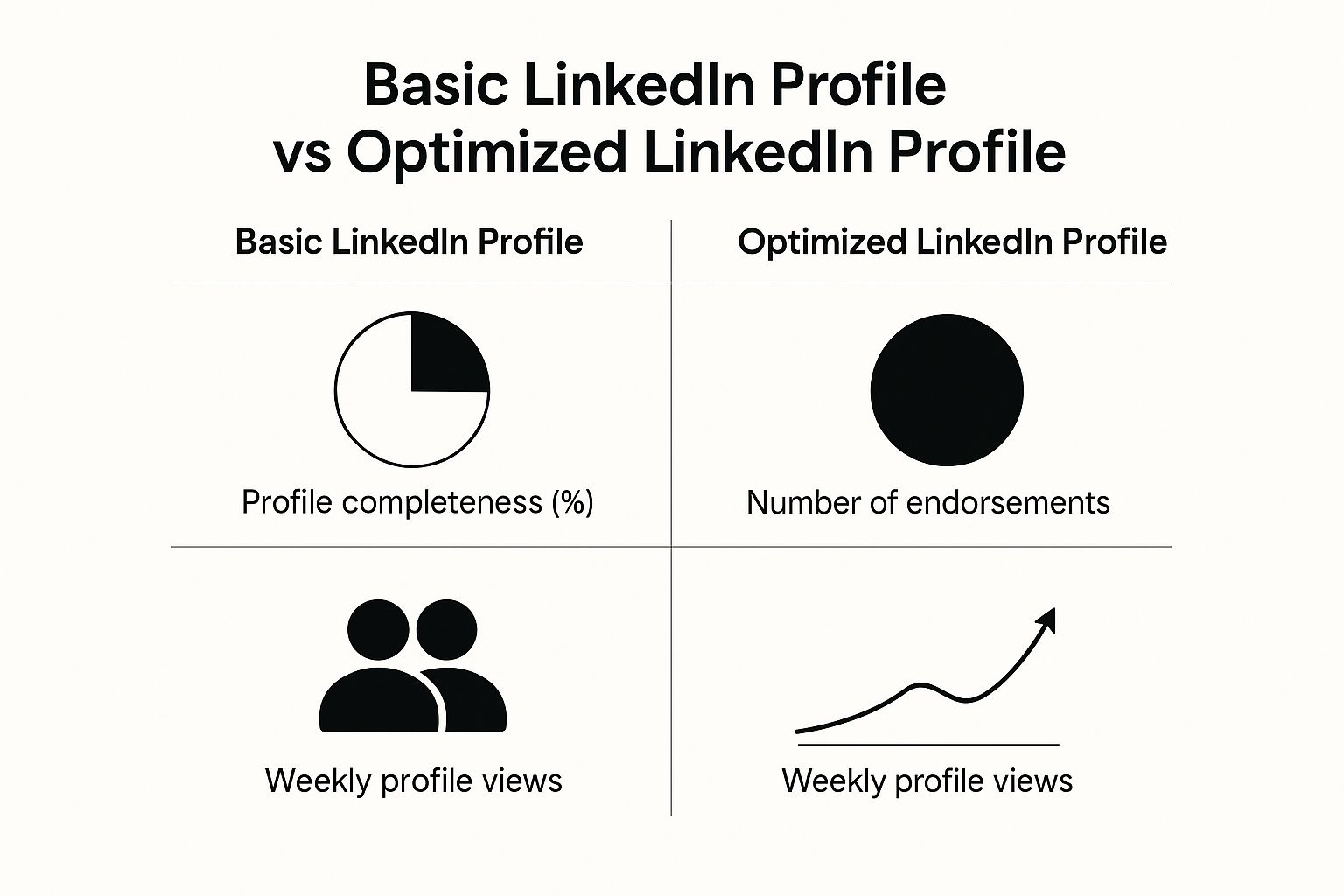
As you can see, a well-crafted profile isn't just about looking professional; it's a tool that actively works for you, attracting more views and engagement from the very people you need to connect with.
Master the Informational Interview
One of the best tools in your networking toolkit is the "informational interview." This is just a fancy term for a short, informal chat where you ask someone about their job, their company, and their industry. The key is that it's not a job interview. It's a low-pressure conversation designed to build rapport and gather intel.
When you reach out, your message needs to be respectful, brief, and all about them.
Here’s an example of an outreach message that actually works:
"Hi [Name], I saw your profile and was really impressed by your work on [specific project or area] at [Company Name]. I'm exploring a career path in [Your Field] and would be grateful for the chance to hear about your experience. Would you be open to a quick 15-minute chat sometime next week?"
This approach is authentic and shows you respect their time. You'd be surprised how many professionals are happy to share their story if you just make it easy for them. These chats not only give you incredible insights but also put you on their radar for when roles do open up.
The table below highlights just how much of a difference a personal approach can make compared to just firing off applications.
Networking Outreach Effectiveness
Outreach Method | Typical Response Rate | Potential Impact on Your Search |
|---|---|---|
Cold Applying Online | 1-3% | Very low. You're competing with hundreds, if not thousands, of other applicants. |
Generic LinkedIn Request | 5-10% | Minimal. Easily ignored and often seen as spammy without a personal touch. |
Personalized Connection | 20-40% | Much better. A custom note shows you've done your homework and respect their time. |
Warm Referral | 50%+ | Game-changing. This is the fastest way to secure an interview and get noticed. |
The numbers speak for themselves. While a warm referral is the ultimate goal, a personalized approach is a massive step up from cold applying and is the foundation for building those stronger connections.
Always remember to send a thank-you note after your conversation. From there, you can keep the connection warm by occasionally following up with a relevant article or a quick update on your search. It's a long game, but building these relationships is the single most reliable way to speed up your job search. For a deeper dive, check out our complete guide on networking for your job search.
Master Your Interviews to Secure the Offer
Think of the interview as the moment your resume gets to breathe. It's your chance to go beyond the bullet points and show a company who you are and the real value you can bring. A killer interview can slice weeks off a company's decision-making time, getting you hired that much faster.
The difference between a good interview and a great one? Preparation. It’s not about memorizing your work history. It’s about drawing a straight line from your experience to their specific problems and positioning yourself as the solution.
Answer Questions with Memorable Stories
You know those "tell me about a time when..." questions? They're called behavioral questions, and they’re designed to see how you actually handle workplace situations. The absolute best way to tackle them is by telling a story using the STAR method.
This simple framework keeps your answers clear, concise, and—most importantly—impactful.
Situation: Quickly paint the picture. What was the challenge you were facing?
Task: What was your specific job or goal in that scenario?
Action: Detail the steps you personally took. This is where you shine, showing off your skills and initiative.
Result: What happened in the end? Use numbers whenever you can to show the real-world impact of your work.
Let’s say an interviewer asks about a tight deadline. You could describe a time a project timeline was suddenly cut by two weeks (Situation). Your job was to deliver it on time without compromising quality (Task). You could explain how you immediately re-prioritized the team's workload and automated a tedious reporting process (Action). The result? You delivered the project a day early and saved the team 10 hours of manual work every single week (Result).
See how much better that is than just saying, "I work well under pressure"?
Research Like a Detective
Anyone can skim a company's "About Us" page. If you want to stand out, you have to dig deeper. Find their latest press releases, read their blog, and see what their execs are talking about on LinkedIn.
This kind of research arms you with the ability to ask truly insightful questions. Instead of the generic, "What's the company culture like?" you can ask something specific like, "I saw you recently launched [new product]. How has that launch shifted your team's priorities for the next quarter?"
An interview is a two-way street. Asking smart, informed questions not only gives you valuable information but also shows the interviewer that you are a serious, engaged candidate who has done their homework.
Prepare for Different Interview Formats
Getting hired is rarely a one-and-done conversation. You'll likely face a few different interview styles, and you need to be ready for all of them.
Phone screens are usually quick gut-checks, so have your elevator pitch polished and ready to go. For video calls, always test your tech beforehand. Make sure your background is clean and professional, and practice looking directly at the camera to make a real connection.
Making a strong visual impression matters, too. For some great tips on what to wear, you can learn how to master the business casual dress code and walk into any room feeling confident.
Ultimately, remember that today's job market moves fast. Having in-demand skills, especially in areas like Generative AI, can significantly shorten your job search. Staying on top of trends by checking out resources like the employment situation summary from the BLS keeps you informed. When you combine solid preparation with a confident delivery, you can turn any interview into a job offer.
Follow Up and Negotiate for a Faster Yes

Here's a hard truth: your work isn't done just because the interview is over. I've seen countless great candidates fade into the background simply because they dropped the ball afterward. What you do after the conversation can be the very thing that pushes you across the finish line ahead of everyone else.
Think of your follow-up and negotiation not as afterthoughts, but as the final, crucial moves in your strategy. This is where you seal the deal and make sure it’s a deal you’re happy with.
The Art of the Strategic Follow-Up
Let’s get one thing straight: sending a thank-you note within 24 hours isn’t optional. It’s expected. But a generic "thanks for your time" email is a missed opportunity. A great follow-up is a strategic tool that keeps you top of mind.
Keep your email short, personal, and to the point. Mention something specific from your chat that stuck with you—it shows you were actually listening.
Even better, use this as one last chance to connect the dots for them. Say the hiring manager mentioned they were struggling with messy project workflows. Your follow-up is the perfect place to briefly mention your experience with a specific project management tool that cleaned up a similar mess at your last job. Suddenly, your thank-you note isn't just polite; it's a final, compelling pitch. For more templates and timing tips, check out our guide on https://jobcompass.ai/blog/how-to-follow-up-after-applying-for-a-job.
Navigate Salary Discussions with Confidence
Ah, the salary question. It always comes up, and fumbling it can slow everything down. If you walk into that conversation unprepared, you risk either getting a lowball offer or accidentally pricing yourself out of a fantastic role. The key is to be informed and ready.
Before you even get on a call, do your homework. Use tools like the Salary Insights feature in Job Compass, Glassdoor, or Payscale to find out what the market is paying for this kind of role, right in your city. That data is your best friend.
When they pop the question about your salary expectations, don't give them a single, rigid number. That can box you in. Instead, offer a well-researched range. Try something like this: "Based on my research for similar roles in this area and my experience, I'm targeting a range of $75,000 to $85,000."
This approach does two things. It shows you’re a professional who has done their research, and it keeps the conversation flexible. You anchor the discussion in a reasonable ballpark, which helps avoid a low offer and keeps the hiring process moving smoothly.
Articulate Your Value to Close the Deal
When an offer finally lands in your inbox, take a breath. You don't have to say yes immediately. It’s completely normal—and smart—to show your excitement and ask for a day or two to look everything over.
If you decide the offer isn't quite right and you want to negotiate, the key is to be professional, not demanding. Frame your counter-offer around the value you bring to the table.
Here’s a simple, effective way to structure that conversation:
Start with enthusiasm: "Thank you so much for the offer! I'm really excited about the opportunity to join the team and help with [mention a specific company goal]."
State your case clearly: "Based on my 10+ years of experience in [your key skill] and the market data for this role, I was hoping for a salary closer to [your desired number]."
Keep it collaborative: "Would it be possible to get to [your counter-offer]? I'm confident my skills in [another key area] will bring a ton of value right away."
This isn’t a confrontation; it’s a partnership. By tying your request back to your experience and market value, you make it much easier for the hiring manager to champion your case and get you to that "yes" faster.
Answering Your Biggest Job Search Questions
A job search can feel like you're navigating a maze in the dark. You know where you want to end up, but the path forward is anything but clear. Let's shed some light on the questions I hear most often from job seekers who want to speed things up.
How Many Jobs Should I Apply to Every Day?
This is the big one, and my answer usually catches people off guard. Forget the old advice about blasting out 50 resumes a day. That's a surefire way to burn out, not get hired.
The real key is quality, not quantity. Aim for 3-5 highly targeted applications each day. This gives you the breathing room to actually customize your resume for the role, write a compelling cover letter, and maybe even do a little detective work to find a contact at the company. Trust me, a few personalized applications will always beat a hundred generic ones.
The most powerful shift you can make is from "how many" to "how well." Getting a 10% callback rate on 10 targeted applications is infinitely better than a 1% rate on 100 random ones. It's just simple math.
Is it Better to Apply on a Company Website or a Job Board?
Job boards like LinkedIn are fantastic for finding openings, but when it's time to apply, going directly to the company's career page is almost always the right move. It puts your application directly into their applicant tracking system (ATS), cutting out any middlemen or potential glitches from third-party sites.
But the best method? Don't use either as your first step. The ultimate fast track is an employee referral. An internal recommendation is the quickest way to get your resume past the bots and in front of a real person. So, find the job on a board, connect with someone at the company, and then apply through the official portal with that warm introduction in your back pocket.
How Long Should I Wait to Follow Up After an Interview?
Timing your follow-up is a delicate dance, but getting it right shows you’re professional and genuinely interested. It really boils down to two key moments.
The Thank-You Note: This isn't optional. You need to send a personalized thank-you email within 24 hours of every single interview. No exceptions.
The Check-In: If the hiring manager gave you a timeline, wait a day or two after that date passes before you send a polite follow-up. If they didn't give you a date, a week is a good rule of thumb before you gently check in for an update.
Ready to stop guessing and start seeing real progress? Job Compass provides the tools to find direct contacts, get your resume AI-optimized, and uncover salary data so you can negotiate like a pro. Start your faster job search with Job Compass today.

